Indoor
Offices, meetings, libraries, hospitals, classrooms, dining rooms. A cap reads as casual; a band reads as athleisure.
Product 01b · Active Thread
The same substrate. Indoor-first.
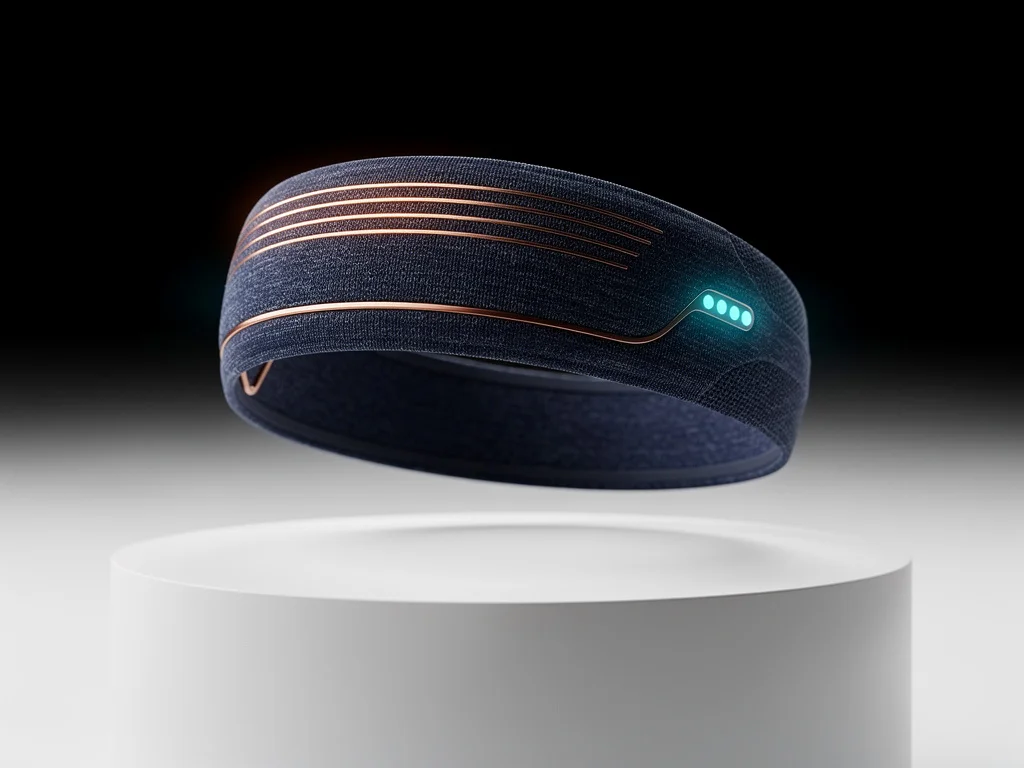
Same Active Thread. Same 16-channel sensing across forehead, temples, and occipital. Same embedding-first protocol. Same calibration. Same open SDK as the Cap. A smaller shell, sized for indoor settings, hot weather, athletic context, professional dress, and any hair, hat, or head covering. Plasticity invested in either device carries to the other.
Form factor
The Cap is the all-day, all-weather, outdoor companion. The Headband is the version you wear when a cap is wrong. Most of the day, in most places, that is most of us.
Offices, meetings, libraries, hospitals, classrooms, dining rooms. A cap reads as casual; a band reads as athleisure.
A cap's crown traps heat. A band breathes. Summer, indoor heat, gyms, kitchens, the tropics, the desert.
Hairstyles, hijabs, kippot, turbans, professional grooming. The band sits underneath, alongside, or invisibly. The cap doesn't.
Cycling, yoga, lifting, running, climbing — bands are already part of the kit. Adding sensing is invisible.
The "I'm sitting down to write, code, design, study, play" device. Two hours of deep work; band on, embedding live, feedback in your stack.
Soft fabric, no rigid components, comfortable to wear in bed. Continuous overnight read into your sleep platform of choice.
Anatomy
The Cap and the Headband cover the same scalp regions because that's where the signal is. The band is the cap minus the crown — and the crown was never where the sensing happened.
Forehead
Temples
Occipital strap
Same 16 sensor inputs as the Cap — 8 EEG · 2 fNIRS · 4 MMG · IMU · PPG.
The band is built around the sensor placement, not around concealing electronics under fabric.
Cap · Band
The Cap and the Headband run the same Active Thread inventory, the same 16-channel placement, the same calibration, and the same frozen embedding. The user picks the shell for the context — Cap outdoors and all-day, Headband indoors and at the desk — and the protocol stays the same. Plasticity is invested in the protocol, not in the shell. Switching between Cap and Band is trivial; the user's nervous system has already learned what it's driving.
Protocol
Plasticity needs a stable target. The Phasal Headband uses the same embedding-first protocol as the Cap: pick an open-weights LLM input embedding (4096-dim), build a thin learnable map from sensor stream to embedding during a short calibration, close the loop with audio and visual feedback, and then never retrain. You learn the band. The band doesn't learn you.
Open SDK, open RISC-V firmware, no required cloud, no required account.
Band-001 · Engineering spec
16ch
8 EEG · 2 fNIRS · 4 MMG · IMU · PPG
4096d
Embedding output
~45g
Weight
≤50ms
Sensor → embedding
28–36h
Battery + harvest
50+washes
Wash class A
RISC-V
Open firmware
BLE5.4
Radio + LE Audio
0cloud
Required services
Band-001 · Active Thread T1 + T2 · ATConnect-8 · Wash Class A · Same protocol as Cap-001
First production run is 100 bands. Made in the Phasal workcell alongside the first Cap run. Hand-finished. Numbered. Reservations open. No deposit required to hold a place; you'll be invoiced when your unit is ready, with a calibration session and an SDK seat.
Reserving both Cap and Band? One calibration covers both — the protocol is shared.