Product 01 · Active Thread

Phasal Cap.

A wearable substrate. Built to be learned.

The Phasal Cap projects a stable embedding into your stack. Your LLM, your XR runtime, your agent, your robot policy — anything that consumes vectors — receives a continuous read of cortical state, motor intent, and autonomic context, in the same high-dimensional space those systems already speak. The model is yours. Your data stays local. The cap is something you learn to drive, the way you learned a keyboard. It gets better the longer you wear it.

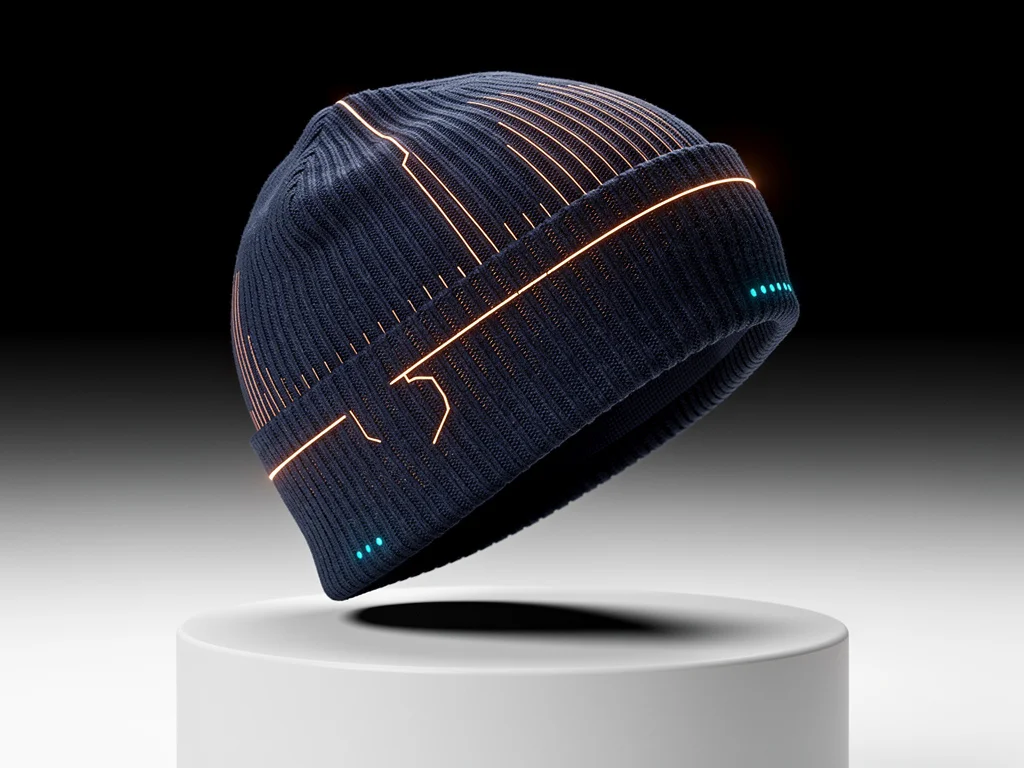
Phasal Cap — knit beanie with Active Thread woven through the rib structure and integrated sensor zones

Thesis

The fabric is the computer.

Brain activity isn't a phoneme stream waiting to be decoded. It is a generative trajectory through a high-dimensional state space — a continuously updated forward model of action and intent. Foundation models — LLMs, diffusion models, robot policies — already operate in that same space.

The Phasal Cap exposes a stable embedding to your stack and lets your nervous system build a forward model of it. The way it built a forward model of a keyboard, a piano, a steering wheel. Plasticity is the bandwidth.

That is the design constraint underneath every other choice: the substrate has to be consistent. Consistent across sessions. Consistent across hair, sweat, motion, and weather. Consistent for years, so the brain has time to learn it. A learnable interface beats a more accurate decoder, every time.
Anatomy

Sensors aren't placed.
They're knit.

Active Thread is woven through every region of the cap. The cap doesn't carry electronics; the cap is the electronics. Cortical, motor, and autonomic signals are read where they emerge — without rigid harnesses, without gel, without the look of medical equipment.

01 · Forehead

Prefrontal cortex

  • ·Dry electrodes at Fp1 / Fp2 / Fpz
  • ·2 fNIRS optode pairs (LED + photodiode)
  • ·Skin temperature, hydration, sweat ions

Bare skin makes prefrontal the easiest scalp region for both electrical and hemodynamic readout. Attention, executive function, neurovascular coupling.

02 · Temples (L/R)

Temporal cortex + facial MMG

  • ·Dry electrodes at F7 / F8 / T3 / T4
  • ·4 magnetomyography channels (differential pair per temple)
  • ·Photoplethysmography over the temporal artery

The temporalis muscle activates during subvocal speech and jaw motion. Magnetic-domain readout works through fabric and hair, immune to skin-impedance drift. HRV from the same zone.

03 · Occipital strap

Visual cortex + mastoid array

  • ·Dry electrodes at O1 / O2 / Oz
  • ·Around-ear flex array on mastoid (cEEGrid pattern)
  • ·Reference channel for common-mode rejection

Occipital coverage delivers visual-cortex SSVEP, motor-imagery context, and steady-state evoked potentials. Mastoid placement gets ear-region signal without anything in the canal.

04 · Distributed

Motion + audio + context

  • ·9-axis IMU (head pose, gesture, artifact rejection)
  • ·MEMS microphone (voice + ambient context)
  • ·Bone-conduction transducer (audio out, no earbuds)

The cap closes the loop. You feel and hear the embedding's effect — the feedback signal plasticity needs to build a stable forward model.

05 · Compute, woven

T3 thread, distributed

  • ·Active Thread T3 chiplets along the band
  • ·Sensor fusion at the fiber level — no off-board data movement
  • ·Quantized embedding extractor on-cap

The cap doesn't have a compute module. Compute is woven through it. Short interconnects, distributed power, the substrate IS the silicon.

06 · Power, harvested

Solar · thermal · motion

  • ·Photo-rechargeable energy textile across the crown
  • ·Body-heat thermoelectric fibers along the sweatband
  • ·Motion-piezo fibers in the rib structure

The whole band is a harvester. No charging ritual. Plugs in only when ambient harvesting is insufficient.

Protocol

Frozen at calibration. Stable for life.

Plasticity needs a stable target. The Phasal Cap protocol is designed around that one constraint.

01

Pick the embedding

The input embedding of an open-weights LLM — Llama, Qwen, Mistral, your choice. 4096-dim. The space is fixed and stable; everything downstream is wired to it.

02

Calibrate

A thin learnable map projects sensor stream to the chosen embedding. Contrastive learning during a short calibration. Then frozen.

03

Close the loop

Audio out via bone conduction. Visual feedback through your screen of choice. Tactile through the band. The user sees and feels the embedding's effect — plasticity does the rest.

04

Never retrain

The map is locked. No silent updates. No adaptive drift. Your nervous system learned this interface — we don't move it under you.

You learn the cap. The cap doesn't learn you.
That asymmetry is the whole architecture.

Your data · your stack · your model

The cap is the substrate.
Everything else is yours.

Phasal Cap streams its embedding over BLE 5.4 to your device. The SDK is open. The firmware is open. The signal stays on your hardware. Pipe it into the foundation model of your choice — your XR runtime, your agent, your medical record, your training app — without a Phasal cloud in the middle, without an account, without telemetry leaving your control.

Open SDK

Rust, Python, Swift, Kotlin. MIT-licensed.

Open firmware

RISC-V, reproducibly built, publicly inspectable.

Local-first

No required cloud. No required account. No telemetry.

The road forward

Three generations. One protocol.

The protocol is what stays constant. The substrate evolves underneath it. Plasticity invested in Cap-001 carries to Cap-N.

Cap-001 · 2026

Hand-finished hybrid

Active Thread T1 + T2 woven through the band, embroidered electrode arrays at the named sites, conventional analog frontend in a small pod, embedding-first protocol locked at calibration. 100 units, made in the Phasal workcell.

Cap-002 · 2027

Fiber-native sensors

T3 compute thread integrated. Magnetomyography moves to woven differential pairs. fNIRS optodes in fiber form. The pod becomes a connector, not a computer. Same protocol, same embedding, same calibration.

Cap-N · the woven cap

Cloth, all the way down

Compute fibers, sensor fibers, power fibers, antenna fibers — a single weave. No module, no socket, no charging port. The band is the computer. The cap weighs what a cap weighs and lasts as long as a cap lasts.

Cap-001 · Engineering spec

By the numbers.

16ch

8 EEG · 2 fNIRS · 4 MMG · IMU · PPG

4096d

Embedding output

≤50ms

Sensor → embedding

~80g

Weight

36–48h

Battery + harvest

50+washes

Wash class A

RISC-V

Open firmware

BLE5.4

Radio + LE Audio

0cloud

Required services

Cap-001 · Active Thread T1 + T2 · ATConnect-8 · Wash Class A

Reserve Cap-001.

First production run is 100 caps. Made in the Phasal workcell. Hand-finished. Numbered. Reservations open. No deposit required to hold a place; you'll be invoiced when your unit is ready, with a calibration session and an SDK seat.

[email protected]